
Advancing Image Processing and Multimodal Fusion | The 2026 International Conference on Image Processing and Multimodal Fusion (IPMF 2026) Successfully Concludes
IPMF 2026 · Online Conference
The 2026 International Conference on Image Processing and Multimodal Fusion (IPMF 2026) was successfully held online. Centering on cutting‑edge research of image processing and multimodal fusion, the conference featured three high‑level keynote speeches and seven youth oral presentations, alongside the review and recognition of Best Paper Award papers. Experts and scholars from home and abroad gathered online. They exchanged ideas on image enhancement, multimodal analysis, machine vision, medical intelligent processing, remote‑sensing image processing and other topics, boosting academic innovation and technology transformation in related research fields.
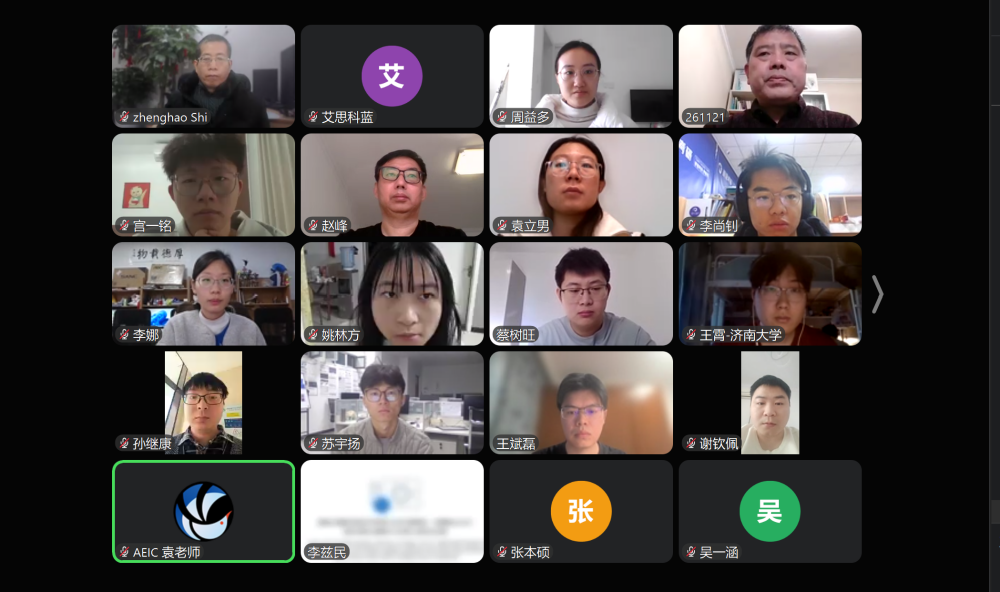
Group photo of online participants
I. Gathering Wisdom Online: Exploring Multimodal Research Frontiers
Hosted in an online format, the conference brought together experts and young researchers from domestic universities and research institutions. In‑depth discussions were carried out on key scientific issues related to image processing and multimodal fusion, building an efficient online platform for academic communication.
II. Keynote Speeches: Exploring Cutting‑edge Academic Frontiers
Three distinguished domestic scholars delivered keynote talks focusing on cutting‑edge directions including imbalanced‑data classification, low‑light image enhancement and AI‑driven multimodal mental‑health technology. Each speech combined theoretical insights with practical engineering value, followed by short Q&A sessions with active online discussions.
Prof. Zhen Zhang, Zhengzhou University, China
Title
Multiple Adaptive Over‑sampling for Imbalanced Data Evidential Classification

Prof. Zhang is a second‑level professor and doctoral supervisor at the School of Electrical and Information Engineering, Zhengzhou University, and Vice President of the Institute of Public Safety of Zhengzhou University. He is a high‑level talent in Henan Province and Deputy Director of the National Engineering Laboratory for Big Data Collaborative Security Technology. A returned scholar from a state‑sponsored program, he is a key teacher in Henan Province and an academic and technical leader of the Henan Provincial Department of Education. He serves as an expert for the Ministry of Public Security's video engineering project; an expert for the Ministry of Industry and Information Technology, the Ministry of Science and Technology and the Ministry of Education; an expert in the artificial intelligence group of the China Security Association; Vice Chairman of the Henan Provincial Machinery and Electrical Standardization Association; and an expert in emergency management, digital government construction, informatization, artificial intelligence and big data, chief science popularization, educational informatization, and public security video surveillance networking application of Henan Province. He has presided over more than 100 major national and provincial scientific research projects and published 90 papers. As project leader, he has won the Second Prize of the Henan Provincial Science and Technology Progress Award, and has twice been awarded the title of "Outstanding Master's Thesis Supervisor of Henan Province". He is also a supervisor of the National Scholarship for Postgraduates and has received titles including "Innovative Leading Talent of Zhengzhou's '1125 Talent Gathering Plan'", "Outstanding Science and Technology Worker of the Chinese Institute of Electronics", "Outstanding Contributor to China's Smart City" and the "Outstanding Contribution Award of China Security Industry".
Over‑sampling approaches focus on generating samples to balance the dataset and have been widely applied in classifying imbalanced data. However, existing approaches do not take into account the uncertainty of generated samples, which may alter the data distribution and introduce uncertain information into the classification process. To tackle this issue, the speaker proposes a multiple adaptive over‑sampling approach (MAO) for classifying imbalanced data based on evidence reasoning. First, balanced training sets are constructed through multiple adaptive over‑sampling for the minority class, which characterizes the uncertainty of over‑sampling. Then, the intra‑ and inter‑class inconsistency of data distribution after over‑sampling is defined to quantify the weights of different classifiers trained by various balanced subsets, weakening the negative impact of changes in data distribution on classification. Finally, neighbor information is employed to revise the results of samples that are hard to classify correctly, avoiding the risk of misclassification caused by uncertain synthetic samples to some extent. The effectiveness of MAO has been verified on several real imbalanced datasets by comparing it with other related approaches.
Prof. Zhenghao Shi, Xi’an University of Technology, China
Title
Image Enhancement for Challenging Low‑Light Environments

Prof. Shi holds a Ph.D. and is a Professor and Doctoral Supervisor, Member of the Academic Committee of Xi’an University of Technology, Distinguished Member of CCF, and one of the "500 Elite Talents" of Taizhou City, Zhejiang Province. He is Chair of the Computer Vision Technology Professional Committee and Deputy Chair of the Biomedical Intelligent Computing Professional Committee of the Shaanxi Computer Federation, and Leader of the Research Team on Intelligent Image Processing and Application at Xi’an University of Technology. His main research interests include machine vision, medical image processing and machine learning. He has published or accepted 40 academic papers as first author or corresponding author, and has been awarded 30 authorized invention patents (including one South African invention patent). He has won two Second Prizes of the Shaanxi Provincial Science and Technology Progress Award (ranking first in one), one Second Prize of the Xi’an Science and Technology Progress Award (ranking first), three Second Prizes of the Shaanxi Higher Education Science and Technology Award (ranking first), one First Prize for Technical Invention of the Shaanxi Computer Federation (ranking first), three Second Prizes for Science and Technology Progress of the Shaanxi Computer Federation (ranking first), and the "Wiley China Open Science High Contribution Author" Award.
In practical applications, the enhancement processing of low‑light and low‑illumination images has always faced the problem of low efficiency and low quality. Drawing on the team's project practice in this field over the past two years, the report introduces the research progress on this issue, with a focus on the team's work and achievements in using deep learning methods for low‑light image enhancement.
Prof. Feng Zhao, Shandong Technology and Business University, China
Title
Intelligent Multimodal Screening and Intervention Technologies and Product Development for Mental Health
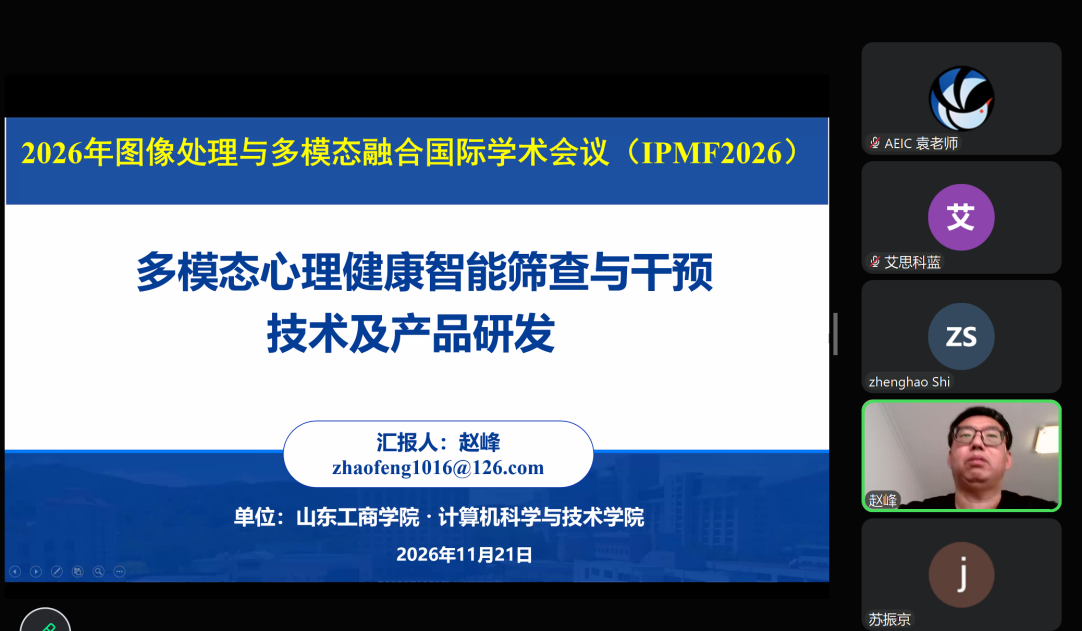
Pioneering "Jin‑Zhi Scholar" young expert. Visiting scholar at the Department of Automation, Tsinghua University and the Medical Image Center, University of North Carolina at Chapel Hill. Director of multiple research platforms, committee member of several academic societies. His research focuses on R&D and industrial transformation of AI‑powered mental‑health technologies. He has led 2 national projects and 5 provincial‑ministerial projects, published over 40 papers, and received the Second Prize of the Shandong Technical Invention Award and the First Prize of the Shandong Teaching Achievement Award.
Focusing on "early screening and early intervention", he demonstrates key multimodal mental‑health screening technologies integrating scales, micro‑expressions, speech and text, and illustrates the industrialization prospect of relevant products.
III. Youth Presentations: Inspiring Innovation from Young Researchers
Following the keynote sessions, seven young researchers from multiple domestic universities and research institutes delivered oral presentations, each limited to 10 minutes. Their works spanned industrial prediction, 3D reconstruction, space remote‑sensing image processing, image segmentation, UAV small‑target detection, medical multimodal classification and other areas. Lively online interactions fully reflected the innovative vitality of the young scientific community.
IV. Best‑paper Recognition & Closing: Looking Forward to Future Collaboration
Upon completion of all academic reports, the conference program committee conducted comprehensive evaluation on all submitted papers from the dimensions of innovation, academic merit and practical application prospect under rigorous, fair and impartial principles and selected the winners of the Best Paper Award. The conference extended warm congratulations to all award‑winning scholars. Winners were reminded to contact the conference secretariat for electronic certificates. Appreciation was also given to all submitting authors for their contributions, expecting more high‑quality research outputs in future work.
All sessions of the 2026 International Conference on Image Processing and Multimodal Fusion (IPMF 2026) have now been successfully completed. This online academic gathering brought researchers together for idea collision and knowledge sharing.
The organizing committee sincerely thanks the keynote speakers, youth presenters, paper authors and every participant. Moving forward, IPMF will keep focusing on image processing and multimodal fusion, build high‑quality academic exchange platforms, promote interdisciplinary innovation and accelerate the transformation of academic findings into real‑world applications. Looking forward to seeing you at the next conference!

IPMF 2026 · Thank You for Joining Us